

5 Core Principles of Family Therapy You Should Know in Minneapolis
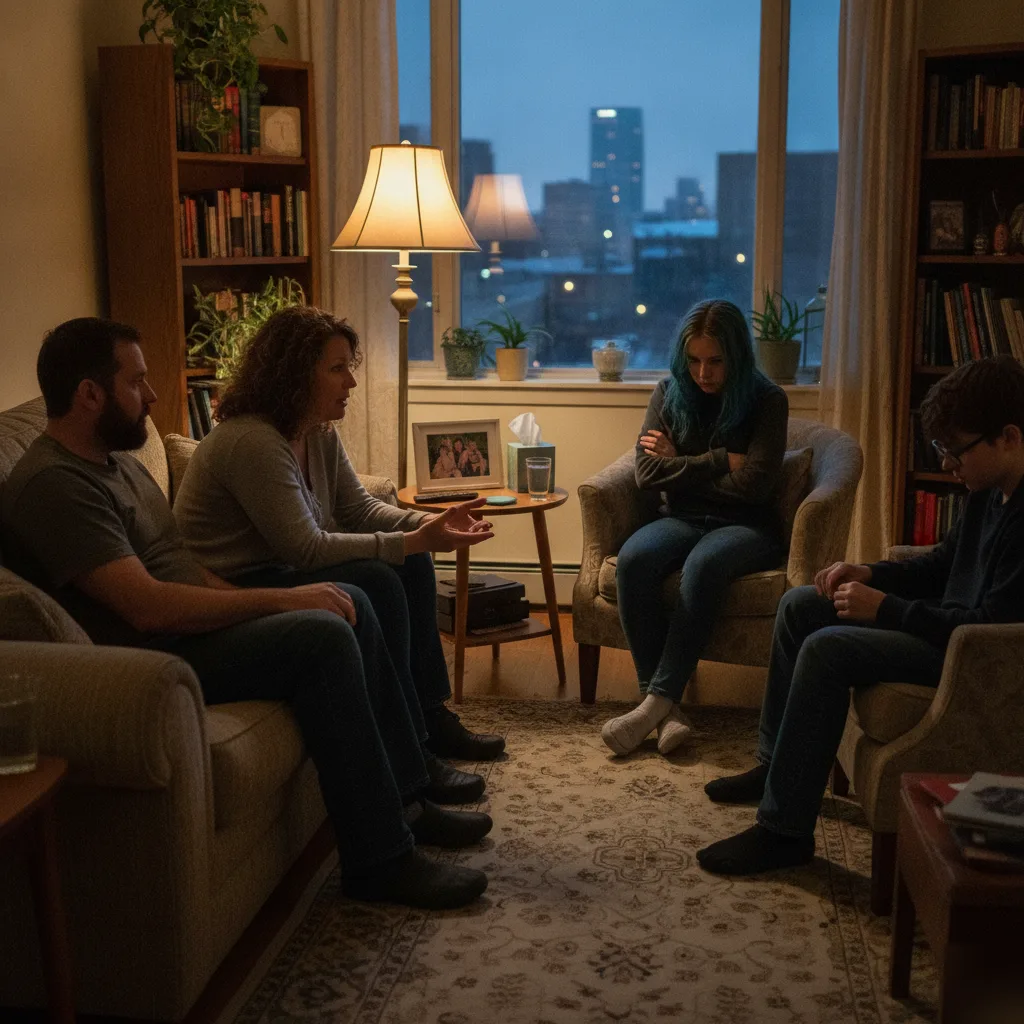
Table of Contents
ToggleWhat Family Therapy’s Core Principles Mean
5 core principles of family therapy you should know are: the family as a system, circular causality, boundaries and roles, communication patterns, and each person’s developmental stage. Together they explain why one person’s struggle almost always ripples through the whole household. Understanding these principles helps you see conflict differently before you ever sit down with a therapist.
If you’ve been Googling why your teenager shuts down at dinner or why every conversation with your partner turns into a fight about the dishes, you’ve probably landed on the term family therapy. But what does that mean? Family therapy isn’t just talking about with an extra person in the room. It’s built on a handful of core ideas that shape how a therapist listens, asks questions, and helps your family shift.
The first principle is that a family works like a system, not a group of separate individuals. Change one part, and the rest adjusts. So when your child’s ADHD symptoms escalate, it’s not just her struggle. It touches your marriage, your other kids, even how much patience you have left at 6 p.m.
The second principle is circular causality. In plain terms, it means blame rarely lands on one person. Your son withdraws, which makes you nag, which makes him withdraw more, which makes you nag harder. Round and round it goes, no single villain.
- Systems thinking: a change in one family member affects everyone, not just the person struggling
- Circular causality: behaviors feed each other in loops instead of one person causing everything
- Boundaries and roles: healthy families have clear but flexible lines between parent and child, partner and partner
- Communication patterns: how a family talks (or avoids talking) often matters more than what’s said
- Developmental stage awareness: a toddler, a teen, and an adult in crisis need different approaches from the same family
We see this mistake all the time in Minneapolis families: everyone focuses on fixing the ‘problem person.’ A parent asks us to just their kid’s OCD behaviors, or a spouse hopes therapy will their partner’s anger. But family therapy looks at the whole pattern. That’s not a dodge. It’s more hopeful, because it means change doesn’t rest on one exhausted person’s shoulders.
Boundaries matter here too. A blended family in South Minneapolis might struggle because a stepparent is trying to discipline before trust is built. That’s a boundary problem, not a personality clash.
And communication patterns are often the loudest clue. Some families go quiet under stress. Others get loud. Neither is wrong on its own, but a therapist trained in family therapy can spot when a pattern has stopped working and start naming it out loud, which is often the first relief a family feels.
The Family Is Treated as One Connected System
Here’s the part most people miss before they start looking into therapy. You brought your kid in because of meltdowns after school, or you booked a session because your partner’s anxiety has taken over dinner conversations. But a good family therapist doesn’t just look at the person with the loudest symptoms. They look at the whole household. That’s the first core idea in family therapy, and it’s the one that changes everything else about how sessions run.
Family systems theory says a family works like a set of gears. Move one, and the others shift too. If your teenager starts refusing school, that’s not happening in a vacuum, it’s connected to sleep patterns, sibling dynamics, maybe a parent’s own stress spilling over without anyone meaning for it to. And if you’ve ever noticed that your calm evening turns tense the second one kid walks in the door upset, you’ve already seen this principle in action.
- One child’s anxiety often shows up as a sibling acting out for attention
- A parent’s work stress can tighten the whole house without a single word said about it
- Co-parenting friction after a divorce tends to surface in a kid’s grades or sleep, not in an argument
- Blended family tension often gets blamed on one ‘difficult’ kid when it’s really about unclear roles
- A caregiver’s exhaustion can quietly shape how patient or short everyone else feels
So instead of asking who’s the problem, a family therapist asks what pattern is running through the house. We see this a lot with parents who come in convinced their child needs to be fixed, only to realize during the first few sessions that the whole family’s communication style needs some retooling. That’s not a criticism. It’s just how systems work.
Think of a family we worked with recently, not their real details, but a common shape. Two parents, one newly blended household, a teenager who’d stopped talking at dinner. Everyone assumed the teen was the issue. A few sessions in, it became clear the whole family had never agreed on new house rules after the blend happened. The silence wasn’t defiance, it was confusion. Once everyone got in the room together, things started shifting fast.
This is exactly why sessions often include more than one family member, sometimes the whole crew, sometimes just a parent-child pair working through a specific conflict. If you’re curious how this plays out in a real session, our
page walks through what to expect, including how we handle things like co-parenting counseling and parent-child conflict resolution for Minneapolis families dealing with exactly this kind of pattern
Patterns Get Treated, Not Just the Person With Symptoms
Here’s something that surprises a lot of Minneapolis families walking into their first session: the therapist isn’t just watching your kid, or your partner, or whoever got labeled the problem. They’re watching the whole room. That’s because family therapy treats patterns, not people in isolation.
Think about it this way. If your teenager slams doors every time homework comes up, the door-slamming isn’t really the issue. It’s one piece of a bigger loop. Maybe you push, they resist, you push harder, they shut down completely. Round and round it goes. A good therapist maps that loop before deciding what to do about it.
We see this mistake all the time: a family shows up expecting the therapist to “” one person. the anxious kid. the withdrawn teenager. the partner who won’t communicate. But people don’t operate in a vacuum, they operate inside relationships. Change the pattern, and the person often changes too.
- Blame cycles, where one family member gets labeled as the source of every conflict
- Triangulation, where a child gets pulled into tension between two parents
- Withdraw-and-pursue loops, common in blended families adjusting to new roles
- Over-functioning and under-functioning pairs, where one person compensates for another
A therapist trained in this approach looks for these loops during early sessions. And once the pattern gets named, out loud, in the room, something shifts. Families stop pointing fingers. They start seeing the shape of the problem together.
Take a common scenario we hear about often in co-parenting counseling. A divorced couple keeps arguing about pickup times, but the real pattern is unresolved resentment from the split leaking into every logistical decision. Fixing the schedule won’t that. Naming the pattern might.
This matters for blended families too, where new step-relationships can accidentally recreate old conflict patterns from a previous marriage.
So what does this mean for you? It means the goal isn’t finding who’s at fault. It’s understanding the dance everyone’s doing, even the parts nobody meant to start. Once you can see the pattern, you can start changing your part in it, without waiting for anyone else to change first.
Frequently Asked Questions
How do I know if my family needs therapy or if this is normal conflict?
You may need family therapy if the same arguments keep repeating without any real change. Normal conflict fades after a talk. A pattern problem keeps coming back, week after week, even when everyone tries to fix it. If dinner tension, silent treatments, or blow-ups feel scripted, that’s a sign the whole system needs support, not just one person. Our Minneapolis page on family therapy patterns walks through more warning signs worth watching for.
What is the biggest misconception people have about family therapy?
The biggest misconception is thinking one family member is the problem who needs fixing. Many Minneapolis parents book a session hoping a therapist will just work on their child’s behavior or their partner’s mood. Family therapy looks at the whole household pattern instead. That’s good news. It means progress doesn’t rest on one exhausted person carrying all the weight alone.
How does a blended family in Minneapolis affect family therapy sessions?
A blended family in Minneapolis often needs extra focus on boundaries before anything else works. Stepparents sometimes try to discipline before trust is built, which creates friction that looks like a personality clash but is really a boundary issue. Therapists slow things down to build trust first, then work on new house rules everyone agrees to. This step matters more in blended households than in traditional ones.
What should I expect during a first family therapy session?
During a first session, expect the therapist to ask questions about the whole family, not just the person with the loudest symptoms. They’ll want to know how everyone talks, who goes quiet under stress, and what roles each person plays at home. It feels less like an interview and more like a conversation. Most families notice the therapist naming patterns out loud, which often brings quick relief.
Why does one person’s anxiety or behavior affect the whole family?
One person’s anxiety or behavior affects everyone because families work like a connected system, not separate individuals. A teenager’s stress can show up as a sibling acting out, or a parent’s work pressure can tighten the whole house without a word being said. Change one part, and the rest shifts too. This is why family therapy treats the pattern running through the home instead of focusing on just one person.
How does communication style affect family therapy outcomes?
Communication style shapes how fast a family responds to therapy, sometimes more than the original problem does. Some Minneapolis families go quiet under stress, while others get loud and argue. Neither style is wrong by itself, but a stuck pattern needs to be named before it can change. A trained therapist spots these patterns early and helps the family build new ways to talk to each other.
Our Insurance Partners
We accept most major insurance plans to make care accessible


Cabot Clients Say
"Sessions with Amanda are empowering."
Sessions with Amanda are empowering. She is a deeply kind therapist who has helped me to process, heal, and develop as a person.
"I have been a client of Cabot since the inception in 2010"
I have been a client of Cabot since the inception in 2010; my experience with the therapists and administrative staff have always been positive. I trust them and have referred both family and friends to Cabot and all have come back thanking me for the referral and have benefited from the caring and compassionate work of the Cabot staff.
"Cabot provides a welcoming and safe environment"
Cabot provides a welcoming and safe environment for those who may be struggling or need additional support. Each time I come for an appointment I am welcomed with a smile and hello not only from my therapist but others who pass through the waiting room.

REACH OUT TO START YOUR HEALING JOURNEY TODAY
Fill out our form or call us directly to learn if Cabot Psychological Services is right for you or a loved one.


WE PROUDLY PARTNER WITH MANY MAJOR INSURANCE PROVIDERS, INCLUDING COMMERCIAL AND MEDICAID